

Conviction Will Be Quiet
How conviction and the TAO flow tweak target the same subnets, and why most owners should never have to think about either.

Compelle (SN82) runs structured debates between AI models to produce higher-quality outputs. Launched mainnet May 8, took over the slot same day after Hermes was deregistered. 4,700 debate games in week one. (x.com)
Oro (SN15) benchmarks AI shopping agents on real e-commerce tasks. Launched the largest open agent competition on Bittensor. Miners submit Python agents scored on live product data, not synthetic tests. (x.com)
MVTRX (SN79) builds decentralized exchange infrastructure for dTAO trading, optimized for AI agents. Validator upgrade expanded simulation capacity to 128 parallel books. Next update adds live Observe Mode, 3D order-book visualization, and a UID relationship explorer. (x.com)
Harnyx (SN67) turns deep research into a commodity. Miners compete to produce traceable research reports faster and cheaper than expert analysis. Positioning for the agent economy as an infrastructure layer. Early-access waitlist open. (x.com)
Cacheon (SN14) rebranded from Taohash to build a dedicated inference competition network. Mainnet targets May 19. Back-to-back AMAs this week generated strong inflow. (x.com)
At first glance, conviction seems to create a market for subnet ownership. Lockers compete, and whoever has the highest EMA wins the seat, making ownership contestable for the first time. That’s how it works in theory. In reality, the way the contest is set up makes most challenges not worth trying. The main impact of conviction at the top of the network has little to do with contests at all.
What a Challenge Costs a Combatant
Conviction applies only to subnets more than a year old. By then, these subnets usually have deep liquidity, an active team, and a high price. To challenge, someone must accumulate 10% of the stake at those prices and lock it publicly for two months before anything happens. The lock is visible right away, giving the owner two full months of warning.
When conviction activates, the challenger’s score asymptotes from zero toward the amount they locked. It climbs slowly over months. The owner can match the lock at any time using the owner key and instantly register full conviction, with no delay or EMA. Other holders can also pool their conviction behind the owner, widening the gap further. The challenger’s months of capital commitment and public exposure can be undone in a single move.
A challenge only succeeds if the owner can’t afford to match the lock.
For subnets where ownership is concentrated, the contest dynamics matter less. These owners aren’t locking to fend off challengers. They’re locking to show they’re committed and not planning to leave. When one entity holds a large share of the supply, the market carries a risk it can’t easily price. A public lock with a visible timeline and decay curve helps manage that risk. At the top, conviction is more about signaling commitment than contesting ownership.
Where Conviction and The Flow Tweak Land
Conviction challenges are likely to succeed only in a narrow set of subnets. These tend to be cases where a team registered early, distributed most of the supply, and now holds a small fraction of the alpha, with no organized holder base willing to lock behind them. These aren’t competitive subnets with two strong claimants. They’re subnets where ownership outlasted the team’s active involvement because the old rules never forced a transfer.
The TAO flow tweak shipping alongside conviction targets the same population from a different angle. Once chain subsidy is subtracted from net flow, subnets without real underlying activity lose their emission share. The top of the network doesn’t change much, but the bottom gets cut off. The subnets losing emissions tend to be the same ones in which the owner is undercapitalized and exposed to a conviction challenge. Both upgrades converge on the same struggling subnets.
Conviction resolves these cases. The previous owner’s history counts for nothing against a present lock. But the mechanism only reaches so far. Where the owner is solvent and attentive, the contest math still applies but overwhelmingly favors the incumbent. Const described conviction as a defensive tool during Thursday’s call, meant to help teams guard against nefarious or spurious attacks. He never framed it as a competitive market. The design matches that intent.
We expect most subnets will sit below 10% locked, keeping the mechanic dormant and ownership stable. Conviction is likely to change the network more by preventing contests than by producing them. At the top, it gives concentrated owners a way to prove commitment. At the bottom, it clears seats that should have been vacated long ago.
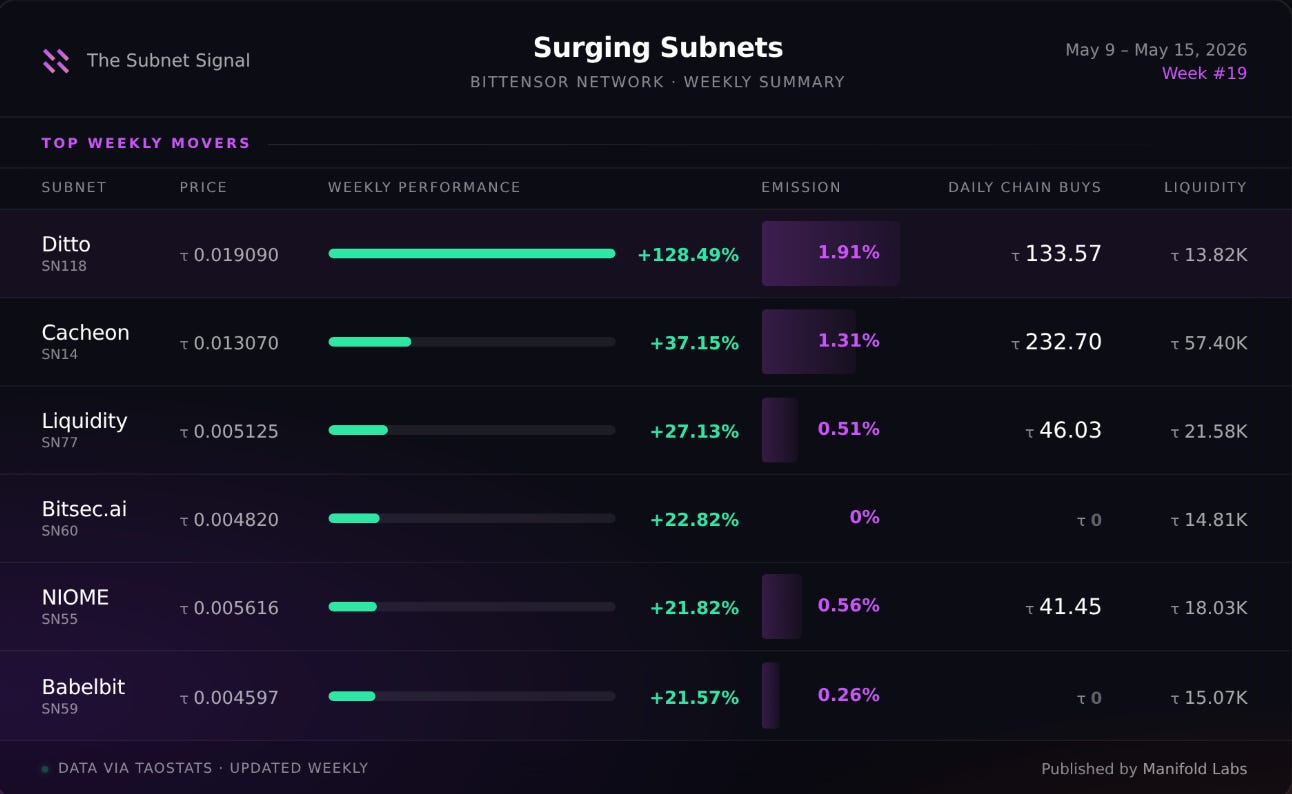
🧠 Ditto (SN118) surged 128% this week. Persistent memory and knowledge graph infrastructure for AI agents. Already powering agents like OpenClaw via MCP with 700+ users. Continued momentum from the slot takeover and open-source launch.
🔧 Cacheon (SN14) gained 37% after back-to-back AMAs with SubnetSummer and on Novelty Search ahead of its May 19 mainnet launch. Rebranded from Taohash to build a dedicated inference competition network.
🔒 Bitsec.ai (SN60) rose 23% this week. Uses AI to automatically find bugs and security issues in code and smart contracts. Recent updates and real customer wins drove interest. This is important because as more AI-generated code is created, preventing hacks becomes critical.
🧬 NIOME (SN55) added 22% this week. Announced a new government partnership in Scotland and an upcoming summit boosted it. This matters because it connects real biology data with AI for better drug discovery and personalized medicine.
🌐 Babelbit (SN59) gained 22% this week. Progress updates and founder interviews created buzz. This is important because it can make high-quality translation cheap and available to everyone globally.